Why Legacy POS Fails Laundromats: 2026 Guide
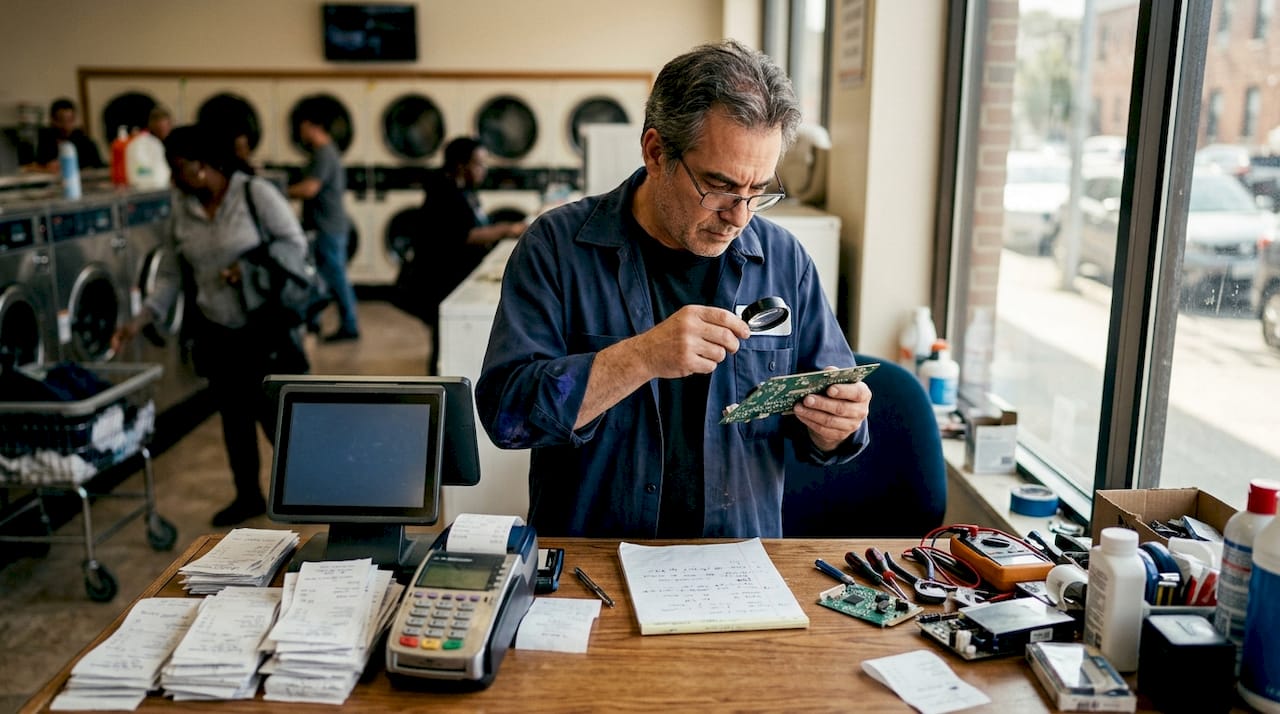
Legacy POS systems are the leading cause of preventable downtime in laundromat operations, and the problem is getting worse as the hardware ages. These systems were built for a different era of retail, not for the coin-heavy, high-humidity, high-traffic environment of a working laundromat. Understanding why legacy POS fails laundromats means looking at three converging problems: fragile hardware chains, poor software integration, and maintenance demands that most operators simply cannot keep up with. 86% of vended laundries in the U.S. and Canada still rely primarily on coin acceptance. That number tells you exactly how slowly this industry has modernized, and why so many owners are still absorbing the costs of outdated systems.
Why legacy POS fails laundromats: the technical root causes
Legacy POS systems in laundromats fail because they depend on too many components that must all work simultaneously. A typical setup includes a central kiosk, a local router, a cloud server connection, and machine control boards that may be 10–20 years old. Any one of those links breaking stops the entire payment chain.
The contrast with a coin jam is instructive. A coin jam takes one machine offline. A failed cloud server connection takes every machine offline at once. That is a fundamentally different category of operational risk, and most owners do not fully appreciate it until they experience a storewide shutdown on a Saturday morning.
Hardware compatibility makes the problem worse. Legacy card readers must interface with machinery that is often 10–20 years old, creating fragile connections that generate frequent service calls. The machine control boards were never designed to communicate with modern payment software. Every firmware update on the POS side risks breaking a connection that was already barely stable.

Software silos compound the hardware problem. Legacy POS systems often operate in closed silos that lack APIs, which means they cannot share data with inventory tools, CRM platforms, or reporting dashboards. You end up with a payment system that processes transactions but tells you almost nothing useful about your business.
Pro Tip: Install a business-grade modem with a 4G SIM failover card. When your primary internet drops, the SIM takes over automatically. This single upgrade eliminates the most common cause of storewide payment failure.
The physical environment of a laundromat accelerates every one of these failure modes. Heat, humidity, lint, and vibration degrade electronic components faster than in a typical retail setting. Onsite POS computers overheat when dust clogs their cooling vents, and most operators do not realize this is happening until the system crashes.
How do legacy POS failures hurt customer experience and revenue?
The revenue impact of a legacy POS failure is immediate and measurable. When the system goes down, customers either leave or get a free machine start because the attendant has no other way to process payment. Both outcomes cost you money directly.
Customer friction starts before a full system failure. Loyalty card programs tied to legacy systems require customers to load money onto proprietary cards, remember PINs, and trust a small business with their payment data. Card systems introduce customer friction through loyalty program hassles, data privacy concerns, and hardware vulnerability that leads to high repair costs. The friction is real, and it drives customers to competitors who accept cash or mobile payments without the extra steps.
The “works without internet” marketing claim from some legacy POS vendors is particularly damaging to owners who believe it. Internet or network failures still impact transaction approval, causing revenue losses and free machine starts even when vendors claim offline capability. Card transactions require bank authorization. That authorization requires internet connectivity. There is no way around this.
“Many owners overestimate the customer-friendliness of card systems. In reality, these systems introduce new operational challenges and customer frustrations that often outweigh the convenience they promise.” — Laundry Biz Center
The customer base of most laundromats makes this worse. Laundromats disproportionately serve cash-preferred customers, including unbanked households and recent immigrants. A system that forces card-only payment or requires a proprietary loyalty card actively excludes a significant portion of your regular customers. That is not a technology problem. It is a revenue problem.
Here is what the failure chain looks like from a customer’s perspective:
- Customer arrives with cash and finds the coin changer broken because the POS kiosk is offline
- Customer tries the loyalty card reader and gets a declined transaction due to a syncing delay
- Customer asks the attendant for help and waits while the attendant calls tech support
- Customer leaves and does not come back
Each step in that sequence is a direct consequence of legacy POS architecture. The system was not designed with your customer’s experience in mind.
What maintenance demands do legacy POS systems place on operators?
Maintenance is where the true cost of legacy POS systems becomes visible. The upfront price of the hardware looks reasonable. The ongoing labor and parts costs tell a different story.
POS computers can last 6–7 years with proper maintenance, and overheating from dust buildup is the leading cause of premature failure. That lifespan assumes you are actively maintaining the system, not just hoping it keeps running. Most laundromat operators are not trained technicians. They are small business owners managing staff, customer complaints, and equipment repairs simultaneously.
The maintenance checklist for a legacy POS system is longer than most owners expect:
- Dust removal: Clean cooling vents and internal components every 3–6 months to prevent overheating.
- Battery backup replacement: Battery backups need replacement every 2–3 years to prevent system freezes during power interruptions.
- Connection checks: Inspect all physical cable connections between the kiosk, router, and machine control boards quarterly.
- Software updates: Apply firmware and software patches promptly, but test on one machine first to catch compatibility breaks.
- Component inventory: Keep spare parts for the most failure-prone components on hand, because vendor lead times can stretch to weeks.
Pro Tip: Set a calendar reminder every 90 days to open the POS computer housing and blow out dust with compressed air. This one habit can add years to the system’s life and prevent the most common cause of unexpected shutdowns.
The deeper problem is that proactive maintenance extends system life but cannot overcome the system’s inherent fragility. You can keep a legacy POS running longer with diligent care. You cannot make it resilient against the fundamental architectural weaknesses that cause storewide failures. At some point, the maintenance cost exceeds the cost of replacement.
Repair economics also favor replacement sooner than most owners realize. When a proprietary kiosk component fails, you are dependent on a single vendor for the replacement part. That vendor may have discontinued the component, or the lead time may be two weeks. Two weeks of downtime in a laundromat is not a minor inconvenience. It is a serious revenue loss.
How do legacy POS systems compare to modern hybrid payment solutions?
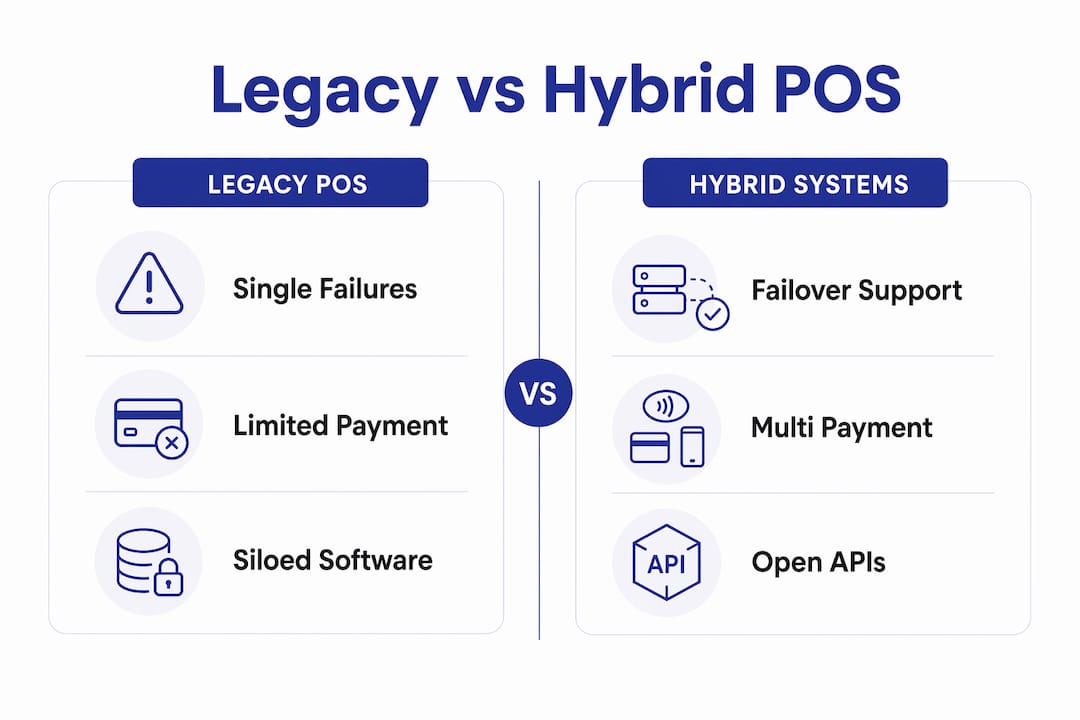
The most practical upgrade path for laundromat operators is a hybrid payment system, not a full replacement of coin acceptance. Hybrid systems support coins, cards, and mobile payments simultaneously, which eliminates the single-point-of-failure problem while preserving the cash-preferred customer base.
| Feature | Legacy POS | Modern Hybrid System |
|---|---|---|
| Payment types | Card or coin only | Coins, cards, and mobile payments |
| Internet dependency | Full dependency, no fallback | Business-grade modem with 4G SIM failover |
| Hardware compatibility | Fragile connections with old machines | Designed for diverse machine hardware |
| API integration | Closed silo, no external connections | Open APIs connecting to CRM and reporting tools |
| Failure impact | Storewide shutdown | Isolated to single payment method |
| Maintenance burden | High, proprietary parts required | Lower, standard hardware components |
| Customer choice | Limited, often card-only | Full range of payment preferences |
The table above shows why the comparison of POS systems for laundromats consistently favors hybrid architectures. The key advantage is not just payment flexibility. It is the decentralization of failure risk. When your card reader goes offline in a hybrid system, customers can still pay with coins or a mobile app. The store keeps running.
Modern hybrid systems also solve the API problem that makes legacy POS so operationally blind. Open APIs allow your payment system to share data with your management software, giving you real-time visibility into revenue by machine, by time of day, and by payment method. That data is how you make decisions about pricing, staffing, and equipment replacement.
The reason many operators maintain coin acceptance alongside modern methods is not nostalgia. It is sound business strategy. Coins require no internet connection, no bank authorization, and no software. They are the most reliable payment method in a laundromat environment. The goal of a modern system is to add payment options without removing that reliability floor.
Key takeaways
Legacy POS systems fail laundromats because their fragile, siloed architecture creates storewide downtime risks that coin-based systems never posed, and no amount of maintenance fully resolves the underlying design problem.
| Point | Details |
|---|---|
| Single point of failure | One failed component in a legacy POS chain can shut down all payments storewide. |
| Maintenance has limits | Diligent upkeep extends POS life to 6–7 years but cannot fix architectural fragility. |
| Customer friction is real | Loyalty card programs and data privacy concerns drive customers away from card-only systems. |
| Hybrid systems reduce risk | Supporting coins, cards, and mobile payments decentralizes failure risk across payment methods. |
| API integration matters | Closed-silo legacy systems block operational visibility that modern open-API platforms provide. |
The uncomfortable truth about POS decisions in laundromats
I have talked with a lot of laundromat operators who made their POS decision based on one number: the upfront cost. That is understandable. Laundromats run on tight margins, and a $15,000 payment system is a serious capital commitment. But the upfront cost is almost never where the real expense lives.
The real cost shows up in service calls at $200 a visit, in two-week waits for a proprietary part that is barely still in production, and in the Saturday afternoon when your entire store goes dark because a router firmware update broke the connection to your cloud server. Those costs do not appear in any vendor’s sales presentation.
What I have found actually works is evaluating POS systems the way you would evaluate any critical piece of equipment: by its failure mode, not its feature list. Ask the vendor what happens when the internet goes down. Ask what happens when the central kiosk is vandalized. Ask how long a parts replacement takes. If the answers involve “call our support line” and “we will get back to you within 48 hours,” that is your answer.
The hybrid approach is not just a technology preference. It is a risk management decision. Keeping coins in your system is not old-fashioned. It is a deliberate choice to maintain a payment method that has zero software dependencies and zero internet requirements. The operators I respect most treat coins as their reliability floor and add modern payment layers on top of that foundation.
One more thing most articles will not tell you: the customer base of a typical laundromat is not the same as the customer base of a coffee shop or a boutique. A significant share of laundromat customers are unbanked or cash-preferred. A system that makes card payment mandatory is not just inconvenient for those customers. It is exclusionary. That is a values decision as much as a technology decision.
— Artur
Kansoflow solves what legacy systems cannot
If the failure patterns described in this article sound familiar, you are not alone. Kansoflow was built specifically for laundromat operators who are tired of storewide shutdowns, proprietary hardware dependencies, and management software that tells them nothing useful.

Kansoflow runs on standard iOS devices, which means no proprietary hardware bundles and no single kiosk that takes your whole store offline when it fails. The platform supports Stripe and Square integrations alongside its visual Kanban order board, photo intake for garment claims, and real-time operational reporting. You get the payment flexibility of a hybrid system with the operational visibility that legacy POS silos never provided. Explore the full feature set for laundromats and see how Kansoflow replaces the fragile legacy stack with something built for how your store actually runs.
FAQ
What is the biggest technical reason legacy POS fails in laundromats?
Legacy POS systems depend on a chain of components, including internet connections, cloud servers, and kiosks, where any single failure stops all payments storewide. A coin jam takes one machine offline; a POS failure takes every machine offline simultaneously.
How long does a laundromat POS system typically last?
With proper maintenance including regular dust removal and battery backup replacement every 2–3 years, a POS computer can last 6–7 years. Without proactive care, overheating causes premature failure well before that window.
Do laundromat card systems really work without internet?
No. The “works without internet” claim is a marketing myth. Card transactions require bank authorization, which requires internet connectivity. Network failures cause revenue losses and free machine starts regardless of what the vendor claims.
Why do most laundromats still use coins if card systems exist?
86% of vended laundries in the U.S. and Canada still rely primarily on coins because coins require no internet, no software, and no bank authorization. They are the most operationally resilient payment method in a laundromat environment.
What is a hybrid payment system for laundromats?
A hybrid payment system accepts coins, cards, and mobile payments simultaneously. It reduces single-point-of-failure risk by decentralizing payment methods, so one failed component does not shut down the entire store.