Why Laundromats Fail Operationally: A 2026 Guide

Operational failure in laundromats is defined as the point where avoidable management breakdowns erode profit margins below sustainable levels. The core causes of why laundromats fail operationally include aging equipment, poor location selection, uncontrolled utility costs, and manual processes that cannot scale. Profit margins typically range 20%–35% after operating costs, but that window closes fast when rent, utilities, or labor run unchecked. Most owners who struggle are not failing because the laundry business is broken. They are failing because they treat a demanding, active business like a passive investment.
Why laundromats fail operationally: equipment and maintenance
Equipment condition is the single most predictable driver of laundromat operational failure. Machines do not fail suddenly. They degrade slowly, and owners who defer maintenance pay for it twice: once in repair bills and again in lost customer trust.
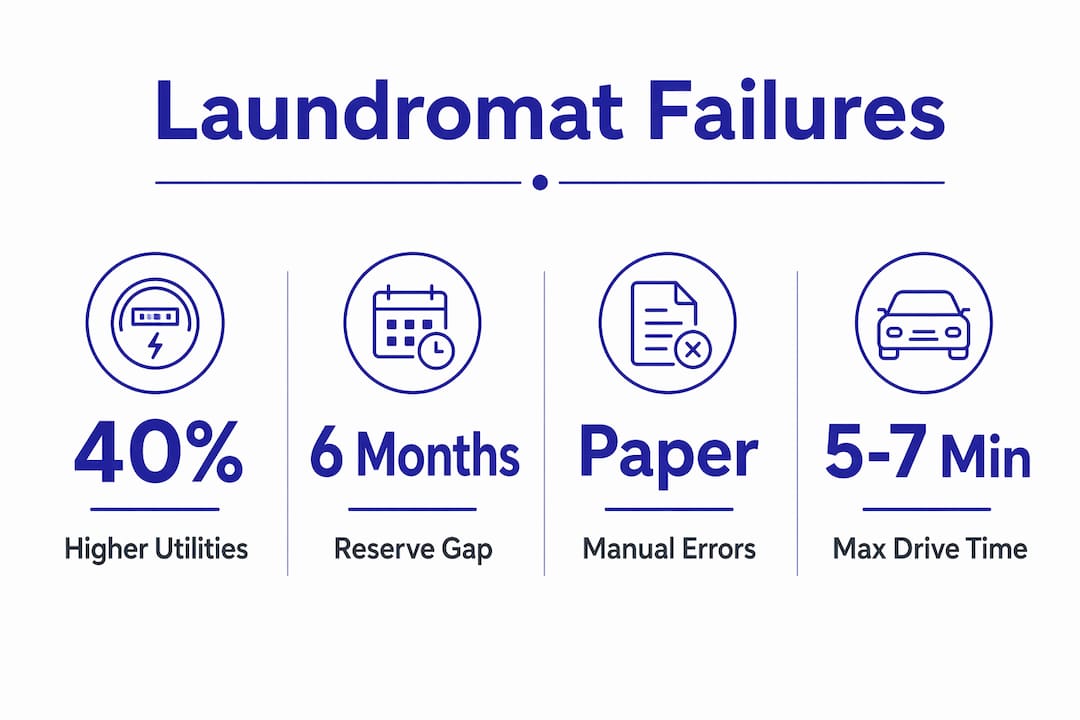
The numbers are stark. Aging machines 10–15 years old consume roughly 40% more utilities and cost about $180 per month each in repairs. Replacing a single 60lb washer runs $8,000–$15,000. That cost hits hardest when owners have no capital reserve to absorb it.
The most common pitfalls operators face with equipment include:
- Deferred maintenance: Skipping small repairs to save cash today creates larger failures tomorrow.
- No replacement reserve: Without a dedicated fund, one machine failure can trigger a cash crisis.
- Ignoring utility signals: A sudden spike in water or gas bills often signals a machine problem, not a rate increase.
- Buying on age alone: A 12-year-old machine with poor maintenance history is a liability, not an asset.
Failure to hold 6 months of operating reserves often causes abrupt collapse after unforeseen costs like sewer repairs, which can reach $15,000 or more. Liquidity is not a luxury. It is the buffer between a bad month and a closed store.
Pro Tip: Build a preventive maintenance schedule tied to machine cycle counts, not just calendar dates. A high-volume washer running 20 cycles a day ages faster than one running 8. Track usage and service accordingly.
Does location really determine laundromat success?
Location is not just a real estate decision. It is an operational one. A store in the wrong spot will never reach the machine utilization rate needed to cover fixed costs, no matter how well it is managed.
40% of U.S. drivers avoid businesses without dedicated parking. For a laundromat, where customers carry heavy bags and often visit weekly, that statistic translates directly into lost repeat business. Parking is not a convenience. It is a retention tool.
The trade area requirements for a viable laundromat are specific:
| Location Factor | Requirement for Viability |
|---|---|
| Drive time to store | 5–7 minutes maximum |
| Neighborhood renter density | High concentration of renters without in-unit machines |
| Dedicated parking | Required; lack of it drives away 40% of potential customers |
| Competitor proximity | Nearby competitors split an already limited customer base |
Growing in-unit washer and dryer penetration in residential buildings is quietly shrinking the addressable market in many neighborhoods. Owners who opened in a high-renter-density area a decade ago may now find that their trade area has shifted. Demographic monitoring is not a one-time task at opening. It is an ongoing management responsibility.
Pro Tip: Before signing a lease or buying an existing store, pull 12 months of utility bills and cross-reference them with machine count and local renter population data. The numbers will tell you whether the location has ever performed at capacity.
How do you control utility and labor costs in a laundromat?
Utilities and labor together represent the largest variable cost block in any laundromat. Mismanaging either one compresses margins faster than any other operational issue.
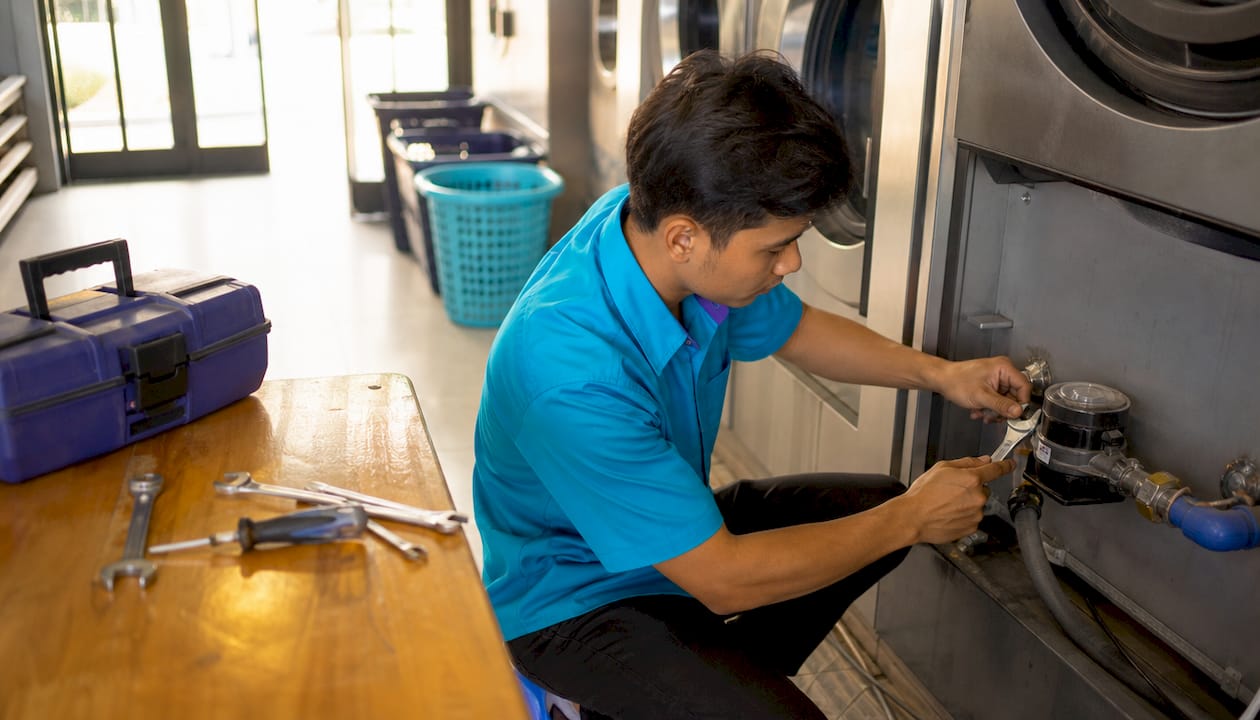
Utilities consume 20%–30% of gross revenue in a typical laundromat. Labor runs 15%–30%, depending on whether the store offers wash-dry-fold or attended services. When both run at the high end simultaneously, the business is mathematically unsustainable.
The steps that separate well-run stores from struggling ones are concrete:
- Review utility bills monthly, not annually. A slow water leak or a malfunctioning heating element will not announce itself. A rising bill will.
- Set utility benchmarks per machine. Know what each washer and dryer should consume per cycle. Deviations signal problems early.
- Schedule wash-dry-fold labor to match demand. Staffing a full crew during slow morning hours burns payroll with no revenue to offset it.
- Audit utility bills over 12–24 months during any acquisition. Hidden overconsumption revealed in utility reviews often signals misrepresented business health or underlying equipment inefficiency.
- Price wash-dry-fold services to recover labor fully. Underpricing this service is one of the most common and costly mistakes in the industry.
Pro Tip: Install sub-meters on your largest water-consuming machines. The data will show you exactly which units are costing you money and give you a defensible case when negotiating utility rates or planning replacements.
How does technology adoption prevent laundromat operational failure?
Manual systems are the silent killer of growing laundromat operations. A paper ticket system and a cash box work fine for one store. They fall apart at two stores and become a liability at five.
Manual management processes that worked for one store often fail at scale. Growth requires centralized digital systems for task management, cash auditing, and maintenance tracking. Without them, owners lose visibility exactly when they need it most.
Security is a related and underestimated risk. Loitering, vandalism, and theft are among the most common causes of operational failure in unattended stores. Proactive remote monitoring and alert systems are not optional extras. They are core infrastructure for any store operating outside attended hours.
Payment systems are another critical gap. Coin-only models carry hidden costs including manual coin counting, bank transport, coin jams, and untracked machine downtime. Operators who rely solely on coins cannot monitor machine status remotely, cannot adjust pricing without physical changes, and cannot capture data on customer behavior. Card and app-based payment systems solve all three problems simultaneously.
The operational advantages of digital management systems include:
- Real-time machine status monitoring to catch downtime before customers do.
- Automated cash auditing that removes the manual reconciliation burden from staff.
- Centralized maintenance logs that create accountability and prevent deferred repairs.
- Remote security alerts that reduce incident response time and deter repeat offenders.
Operators using integrated technology stacks report better cash auditing, maintenance management, and customer communication, reducing operational risks across the board. That is not a coincidence. It is the direct result of replacing guesswork with data.
What value-added services increase laundromat profitability?
Self-service laundry alone leaves significant revenue uncaptured. The machines are already there. The water and gas are already running. Adding wash-dry-fold, pickup and delivery, or dry cleaning drop-off converts idle capacity into higher-margin revenue with relatively low incremental cost.
Laundromat capacity is fixed and perishable. An idle machine at 10:00 AM on a Tuesday cannot make up that lost revenue later. Wash-dry-fold fills off-peak hours with attendant-driven work that generates more revenue per pound than self-service. Pickup and delivery extends the store’s trade area beyond the 5–7 minute drive radius that limits walk-in traffic.
The key services worth adding, and the operational considerations for each, are:
- Wash-dry-fold: Requires trained staff, clear pricing per pound, and a garment tracking system to prevent lost-item disputes.
- Pickup and delivery: Adds route management complexity but dramatically expands the customer base.
- Dry cleaning drop-off: Low overhead if outsourced to a partner facility; adds a premium service tier without capital investment.
- Loyalty and subscription pricing: Card and app payment systems make recurring billing possible. Coin-only stores cannot offer this at all.
Underpricing any of these services is a common laundromat management challenge that compounds over time. A wash-dry-fold price set too low to attract customers will attract high volume at a loss. Price it to recover labor, overhead, and a reasonable margin, or do not offer it.
The discipline most operators underestimate
Running a laundromat well is not complicated. It is just relentless. The operators I have seen struggle most are not the ones who made one big mistake. They are the ones who made a hundred small decisions to defer, ignore, or manually manage things that should have been systematized years earlier.
The uncomfortable truth about laundromat management challenges is that the business punishes passivity faster than almost any other retail format. Active management of utility costs and machine utilization is not optional. It is the job. Owners who treat their store as a vending machine that runs itself will eventually face a repair bill, a security incident, or a utility spike they cannot absorb.
Technology is not a magic fix. But it removes the friction that causes good operators to fall behind. When you can see machine status, cash flow, and maintenance history from your phone, you make better decisions faster. When your staff can process a wash-dry-fold order with photo intake and a printed tag in under two minutes, you lose fewer garments and fewer customers. The digital tools available today for laundromat operators are genuinely better than what existed five years ago. The operators who adopt them early build a structural advantage that is very hard for competitors to close.
My honest advice: stop auditing your store once a month. Audit it every week. The data will show you problems before they become crises.
— Artur
Kansoflow helps laundromat owners avoid these failures
Operational failure rarely arrives all at once. It builds through small gaps in visibility, slow garment tracking, and payment systems that cannot keep pace with a busy floor. Kansoflow is a native iOS POS and management platform built specifically for laundromat owners who want to close those gaps before they cost real money.

Kansoflow’s Visual Kanban Board tracks every order through Wash, Fold, Dry Cleaning, and Ready stages in real time. Photo Intake captures garment condition at drop-off, which eliminates the lost-item disputes that damage customer relationships. Stripe and Square integrations replace coin-only friction with card and contactless payments that work faster and generate auditable revenue data. For owners managing multiple locations, inter-branch transfer support and centralized reporting give you the visibility that manual systems cannot. See the full feature breakdown or review pricing plans to find the right fit for your operation.
Key Takeaways
Laundromats fail operationally because avoidable management gaps in equipment, location, utilities, and technology compound until margins collapse.
| Point | Details |
|---|---|
| Equipment drives hidden costs | Machines 10–15 years old consume 40% more utilities and cost ~$180/month each in repairs. |
| Location is an operational decision | Without dedicated parking, 40% of potential customers will not stop; trade area density determines machine utilization. |
| Utilities and labor must be benchmarked | Utilities consume 20%–30% of revenue; labor runs 15%–30%. Both must be tracked monthly, not annually. |
| Manual systems fail at scale | Digital management tools for cash auditing, maintenance, and security are required for multi-location growth. |
| Value-added services fill idle capacity | Wash-dry-fold and pickup/delivery convert off-peak machine time into higher-margin revenue. |
FAQ
What is the most common reason laundromats fail?
The most common reason is margin compression caused by unmanaged utility costs, deferred equipment maintenance, and poor location selection. When rent and utilities together exceed 30% of gross revenue, the business becomes unsustainable without significant volume.
Why do laundromats lose garments?
Laundromats lose garments primarily because they rely on paper tickets and manual handoffs with no photo record at intake. A digital garment tracking system with photo documentation at drop-off eliminates most lost-item disputes before they start.
How much should utilities cost as a percentage of laundromat revenue?
Utilities should run 20%–30% of gross revenue in a well-managed laundromat. Costs above that threshold signal equipment inefficiency, pricing gaps, or overconsumption that requires immediate investigation.
Can a coin-only laundromat compete in 2026?
A coin-only laundromat faces structural disadvantages including manual cash handling overhead, inability to offer flexible pricing, and no remote machine monitoring. Card and app payment systems reduce downtime and enable subscription and loyalty pricing that coin-only stores cannot match.
How many months of operating reserves should a laundromat hold?
A laundromat should hold at least 6 months of operating reserves. Unexpected costs like sewer repairs can reach $15,000 or more, and stores without liquidity often close abruptly despite appearing profitable on paper.