Why Laundromat Owners Struggle Scaling Their Business

Scaling a laundromat business is harder than most owners expect. The core reason why laundromat owners struggle scaling comes down to three compounding problems: manual operations that eat management time, utility costs that quietly destroy margins, and a customer base that churns faster than it grows. Industry profit margins run 20–35% after costs, which sounds healthy until utilities consume 20–30% of gross revenue on their own. Add deferred maintenance, coin-only payment systems, and no real customer data, and the path from one location to three becomes a grind most operators never finish.
Why laundromat owners struggle scaling: the operational bottleneck
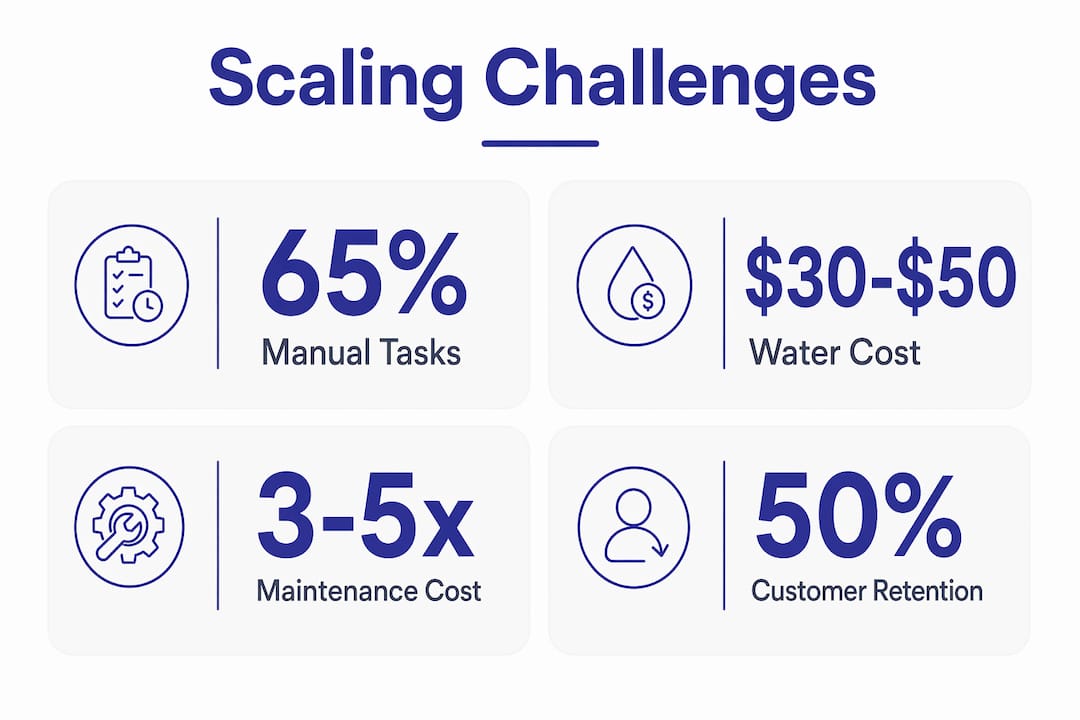
Operations managers at growing laundromat chains spend 60–70% of their time on manual coordination tasks that automation could handle. That means scheduling, machine status checks, inventory counts, and staff follow-ups are consuming the majority of a manager’s day. At one location, that overhead is manageable. At three or more, it becomes the ceiling on growth.

Maintenance compounds the problem fast. Reactive maintenance costs 3–5 times more than preventive maintenance. An owner who fixes machines only when they break will spend far more per repair than one running scheduled service intervals. That cost gap widens with every location added.
The fix starts before expansion, not after. Standardized written SOPs for audits, maintenance schedules, and customer service protocols are the foundation of any multi-location operation. Without them, every new location inherits the chaos of the first one. Owners who skip this step find that delegating becomes nearly impossible, because there is nothing documented to delegate.
Here is what the operational gap looks like in practice:
- Manual scheduling: Staff shifts managed by text or paper, with no visibility into coverage gaps across locations
- Reactive repairs: Machines flagged by customers, not by inspection logs, leading to longer downtime and higher repair bills
- No inventory system: Detergent, supplies, and parts tracked by memory or spreadsheet, causing both shortages and over-ordering
- Undocumented processes: New attendants learn by watching, not by reading, creating inconsistency across shifts and stores
Pro Tip: Before opening a second location, spend 30 days documenting every repeatable task at your first store. If you cannot hand a new hire a written process and have them execute it correctly, you are not ready to expand.
How utility costs and capital expenses limit laundromat profitability
Utilities are the largest single expense in most laundromats, and owners routinely underestimate how much they grow with scale. When utilities consume 20–30% of gross revenue, a pricing structure that worked at one location may produce negative margins at a second one with older equipment or higher local water rates.
The smarter operators validate revenue against actual consumption data. Water consumption benchmarks of $30–$50 per gallon give buyers a reliable way to cross-check reported revenue when acquiring a new store. If the claimed revenue does not match the water bill, the numbers are inflated. This single check has saved operators from overpaying for underperforming stores.
Deferred equipment maintenance creates a second financial trap. Equipment replacements can exceed $250,000 within a few years when maintenance is neglected. An owner who delays washer and dryer servicing to protect short-term cash flow often faces a capital crisis at exactly the wrong moment, right when they are trying to fund expansion.
Pricing inertia makes both problems worse. Owners who have not raised prices in years, or who still rely entirely on coin payments, have no mechanism to pass cost increases to customers. The result is margin compression that accelerates as the business grows.
Key financial risks to address before scaling:
- Utility audits: Review water, gas, and electric bills monthly and compare against machine turns to catch waste early
- Lease terms: Secure long-term leases before investing in equipment upgrades; a short lease makes capital investment indefensible
- Equipment cycles: Budget for machine replacement on a fixed schedule, not when failure forces the issue
- Pricing reviews: Raise prices annually, even by small amounts, to stay ahead of utility and labor cost increases
Highly profitable laundromats manage machine utilization by tracking turns per day, using off-peak pricing, and layering services to reduce idle capacity. Idle machines during slow hours are not just lost revenue. They are utility costs with no return.
Why customer retention is the real obstacle to laundromat growth
Growth measured only by new customer acquisition is a flawed metric. Sustaining growth depends far more on retaining existing customers and increasing their lifetime value. Most laundromat owners do not track retention at all, which means they have no idea whether their marketing spend is building a business or just replacing customers who left.
The benchmark is clear. Retention above 50% of active users per quarter signals a stable, healthy store. Below that, the business is running to stand still. Every dollar spent acquiring a new customer is offset by the revenue lost from one who stopped coming.
The structural problem is coin-only operations. Static coin-only payment systems have no pricing power, no customer data capture, and no CRM capability. An owner cannot run a loyalty program, send a promotion, or even know who their best customers are. Digital payment platforms change that entirely. Phone number capture through apps enables dynamic pricing, subscription models, and targeted outreach that coin machines will never support.
Wash-dry-fold and pickup-and-delivery services generate 30–40% net margins, compared to 18–25% for self-service-only models. These services also build stronger customer relationships because they require trust and repeat interaction. A customer who drops off laundry every week is far more loyal than one who walks in when a machine is available.
Retention tactics that work in practice:
- Loyalty programs: Reward repeat visits with credits or free cycles, tracked through an app rather than a punch card
- Subscription plans: Offer monthly wash-dry-fold packages at a slight discount for prepayment, locking in revenue and visits
- Google review campaigns: Ask satisfied customers for reviews at the point of service, building local search visibility
- App-based communication: Send push notifications for promotions, machine availability, or order-ready alerts
Pro Tip: Track your retention rate every quarter by counting how many customers from the previous quarter returned. If that number is below 50%, fix retention before spending another dollar on acquisition.
What a practical scaling strategy actually looks like
The Crawl, Walk, Run framework is the most disciplined approach to laundromat expansion. It means adding services and locations only after the previous stage is stable and profitable. Owners who skip straight to multi-location expansion without mastering their first store almost always create operational chaos that damages the brand and strains cash flow.
Here is how the framework applies in practice:
- Crawl (single location, self-service only): Master machine uptime, utility management, and customer experience. Document every process. Hit consistent turns-per-day targets before considering anything else.
- Walk (add wash-dry-fold and digital payments): Introduce attendant services and app-based payments at the existing location. Build a customer database. Test pricing flexibility and measure retention.
- Run (multi-location or pickup-and-delivery): Expand only when the first location runs without your daily presence. Use KPIs like utility cost ratios, turns per day, and quarterly retention to validate readiness.
The mindset shift is just as important as the operational steps. Scaling requires moving from hands-on operator to infrastructure investor, managing leases, equipment cycles, and system workflows rather than running machines personally. Owners who stay in operator mode cannot build the systems that make delegation possible.
Build commercial accounts and wash-dry-fold routes within a defined geographic radius before opening a second retail location. A route of 10–15 commercial clients, such as gyms, salons, or small hotels, creates predictable revenue that self-service walk-ins cannot match. That revenue base makes the financial case for a second location far stronger.
Pro Tip: Use your KPIs as a readiness checklist. If turns per day, utility cost ratio, and quarterly retention are all hitting target at your first store, you have the data to justify expansion. If any one of them is off, fix it first.
Key Takeaways
Laundromat owners who scale successfully treat operations, finances, and customer retention as interconnected systems, not separate problems to solve one at a time.
| Point | Details |
|---|---|
| Manual operations cap growth | Automating coordination tasks frees management time and reduces errors across multiple locations. |
| Utilities demand active management | Tracking water and energy costs monthly against machine turns prevents margin erosion at scale. |
| Retention beats acquisition | Keeping more than 50% of active customers per quarter is the clearest sign of a healthy, growing store. |
| Digital payments unlock revenue | App and card systems enable dynamic pricing, loyalty programs, and customer data that coin-only operations cannot provide. |
| Crawl, Walk, Run before expanding | Adding locations before mastering the first store creates operational complexity that compounds with every new site. |
The uncomfortable truth about laundromat “passive income”
I have talked with a lot of laundromat owners who bought their first store expecting it to run itself. The “passive income” narrative is everywhere in this industry, and it is almost entirely misleading. A laundromat can become a low-touch business eventually, but only after you have done the hard work of building systems, training people, and investing in the right tools.
The owners I have seen scale successfully share one trait: they treated their first location like a laboratory. They documented everything, tested pricing, tracked retention, and fixed utility waste before they ever looked at a second store. The ones who struggled did the opposite. They assumed the second location would fix the problems of the first, and it never does.
Digital tools are not optional at scale. Paper tickets, manual scheduling, and coin-only machines are not just inefficient. They actively prevent growth by making it impossible to capture customer data, manage multiple locations remotely, or price services dynamically. The shift to digital-first operations is not a technology upgrade. It is a business model upgrade.
The hardest part of scaling is not finding the capital or the location. It is accepting that the business needs to run without you at the center of it. That requires systems, documentation, and tools that most owners do not put in place until they are already overwhelmed. Start building them at location one, before you need them.
— Artur
Kansoflow: built for laundromat owners who are ready to grow
Scaling a laundromat without the right tools means adding complexity with every location. Kansoflow is a native iOS POS and operations platform built specifically for independent and multi-location laundromat owners who are done managing their business on paper.

Kansoflow replaces manual coordination with a visual Kanban board that tracks every order through Wash, Fold, Dry Cleaning, and Ready stages in real time. It supports Stripe and Square payments, enabling the digital payment penetration that drives retention and dynamic pricing. Photo intake at the counter eliminates lost-item disputes. Inter-branch garment transfers make multi-location management practical without adding management overhead. If you are building the systems that make scaling possible, explore Kansoflow’s features and see how it fits your operation.
FAQ
Why do laundromat owners struggle scaling their business?
The primary obstacles are manual operations that consume management time, utility costs that erode margins, and the absence of customer retention systems. Owners who lack digital infrastructure cannot capture the data needed to manage growth across multiple locations.
What profit margins should a laundromat hit before expanding?
Industry profit margins typically run 20–35% after costs. Before expanding, owners should confirm their existing location consistently hits that range and that utility costs stay within 20–30% of gross revenue.
How important is customer retention for laundromat growth?
Retention above 50% of active users per quarter signals a stable business. Owners who focus only on new customer acquisition without tracking retention are often replacing lost customers rather than growing their base.
What services increase laundromat profitability the most?
Wash-dry-fold and pickup-and-delivery services generate 30–40% net margins, compared to 18–25% for self-service-only models. These services also build stronger customer loyalty than walk-in self-service alone.
When is a laundromat owner ready to open a second location?
A second location makes sense when the first runs without the owner’s daily presence, KPIs like turns per day and retention are consistently on target, and all core processes are documented and delegable.