What Is a Laundromat Branch Network? Owner’s Guide

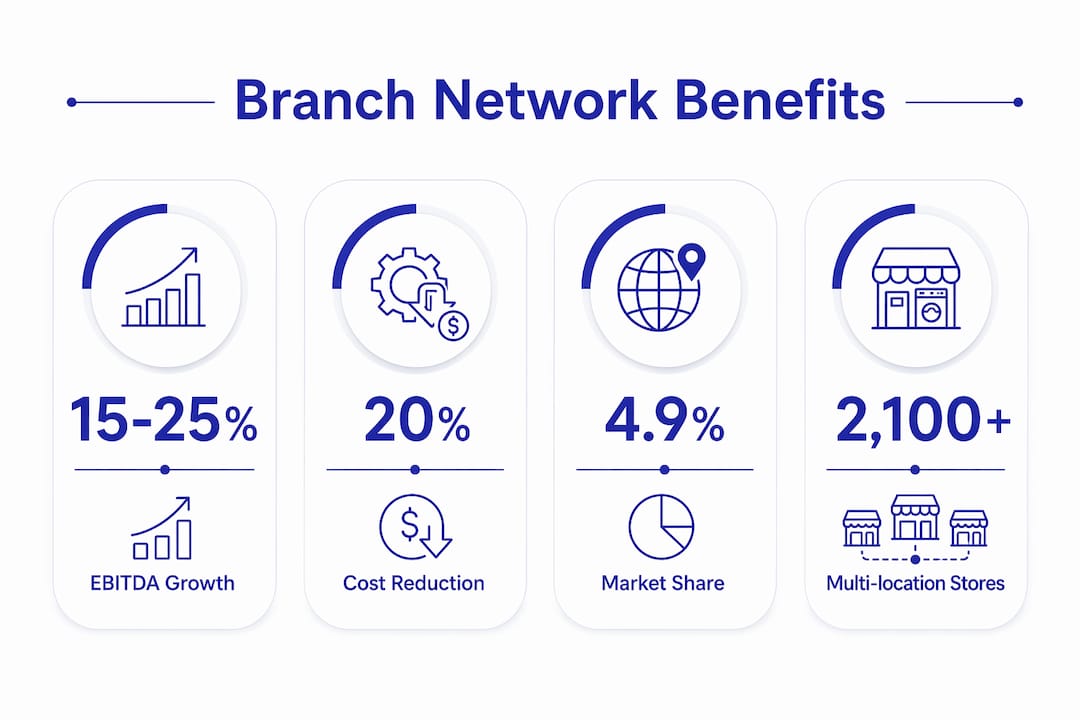
A laundromat branch network is a multi-location business model where an owner operates two or more laundromat stores under centralized management systems, shared branding, and unified financial controls. The model is far rarer than most people assume. About 95% of the 43,308 US laundromats operate as single-store independents, with only around 2,128 stores belonging to multi-location groups. That gap represents a real opportunity. Owners who build a branch network gain cost advantages, higher valuations, and the ability to add revenue services that a single store simply cannot support at scale.
What are the operational benefits of managing a laundromat branch network?
A multi-location laundromat network produces measurable cost reductions that a single store cannot replicate. Multi-unit operations carry 50–70% lower payroll and HR costs per store, 10–20% lower insurance premiums, and 5–15% bulk equipment discounts compared to single-store operators. Those savings compound quickly across three, five, or ten locations.
Revenue growth is just as significant. Centralized wash-dry-fold and pickup/delivery services added across a network yield 30–60% revenue growth beyond coin-only models. A single store adding wash-dry-fold is a nice upgrade. A network of eight stores adding it becomes a logistics operation with real margin.
Shared marketing and administrative functions also increase profitability. One marketing budget, one accountant, and one operations manager can cover multiple locations far more efficiently than hiring separately for each store. The fixed cost spreads across more revenue.
Key operational benefits include:
- Lower labor costs per store through shared regional managers and attendants
- Bulk purchasing power on detergent, supplies, and equipment
- Centralized customer communication via one platform across all locations
- Shared delivery infrastructure for pickup and drop-off services
- Unified compliance and HR reducing administrative duplication
Pro Tip: Add wash-dry-fold as a centralized service before you open your third location. The logistics infrastructure you build for two stores scales to five with minimal added cost.
How do laundromat branch networks manage multiple locations effectively?
Effective multi-location management depends on three pillars: technology, geography, and legal structure. Get all three right and the network runs with less friction than a single poorly organized store.

Technology as the operational core
Manual processes are major liability factors that prevent scalable growth. Operators who rely on paper tickets, cash counts done by memory, and phone calls to check on staff cannot manage more than two or three locations before things break down. Central digital hubs enable real-time cash auditing, task management, and remote monitoring across every store simultaneously. Platforms like Kansoflow replace fragmented paper-based workflows with a visual Kanban board, photo intake at the counter, and inter-branch garment transfer tracking built directly into the point-of-sale system. Operators combining AI-powered communication, smart locks, and remote monitoring scale more effectively and reduce the manual burden on owners.
Geographic clustering
Success in multi-location laundromat operations relies on geographic density within 20-minute drives between stores. That proximity allows one regional manager to cover multiple locations in a single day. It enables shared service contracts with one plumber, one electrician, and one equipment technician. Scattered stores across different cities multiply management complexity and eliminate those shared-resource advantages entirely.
Legal and accounting structure
Holding company structures with separate accounting units for each store simplify financing, tax planning, and eventual exit strategy. Each store operates as its own entity under a parent holding company. This structure makes it easier to secure loans against individual stores, sell one location without disrupting the others, and present clean financials to investors or buyers.
Pro Tip: Set up your holding company before you acquire your second store. Restructuring after the fact is expensive and time-consuming.
The four steps to build an effective management structure:
- Adopt a centralized POS platform that covers all locations from one dashboard
- Cluster acquisitions geographically to share staff and service contracts
- Standardize equipment across stores to reduce maintenance complexity
- Create a holding company with individual store subsidiaries before scaling past two locations
What are the common models of laundromat branch networks?
Three distinct models define how operators structure their laundromat branch system. Each carries different capital requirements, growth potential, and operational control.
Independent regional operators own a cluster of stores within one metro area or region. They control all decisions, keep all profits, and bear all risk. This model offers the highest control and the most direct path to building equity. Most successful multi-location laundromat owners start here.
Multi-market regional operators span multiple cities or metro areas. They require stronger management infrastructure because geographic density becomes harder to maintain. These operators typically build or hire a dedicated operations team and invest heavily in technology to compensate for the distance between stores.
Franchise operators pay royalties and fees to a parent brand in exchange for a proven system, national marketing, and supplier relationships. The laundromat franchise model reduces startup risk but limits profit margins and operational flexibility. Franchise fees typically reduce the owner’s take-home income compared to an independent operator running the same volume.
The key differences across models:
- Control: Independent operators have full control; franchise operators follow a prescribed system
- Capital requirements: Franchises often require higher upfront fees; independent acquisitions vary by market
- Growth speed: Franchise systems provide a replicable template; independent operators build their own systems
- Valuation: Independent platforms with strong technology integration often attract comparable or higher multiples than franchise units
Equipment standardization across the network reduces maintenance challenges and improves customer recognition regardless of which model you choose. Mixed, aging machines across locations create inconsistent customer experiences and unpredictable repair costs.
What are the financial and valuation advantages of laundromat branch networks?
Multi-location laundromat platforms command significantly higher valuations than single stores. Multi-unit platforms trade at 4.0x–4.5x Seller’s Discretionary Earnings (SDE) multiples, compared to 3.2x–3.8x for single-store assets. On a business generating $300,000 in SDE, that difference represents $180,000–$390,000 in additional exit value.
The margin improvements are equally compelling. Regional consolidators experience 5–8% revenue growth and 15–25% EBITDA margin improvements post acquisition. Those gains come from the cost efficiencies described earlier, combined with the revenue lift from centralized services. Investors and private equity groups actively seek consolidated laundromat platforms because the model produces predictable cash flow with real upside from operational improvement.
Multi-unit scale also unlocks larger financing options. A single store owner typically accesses SBA 7(a) loans or seller financing. A platform with five or more locations can access commercial real estate financing, SBA 504 loans, and private credit facilities at better rates. The network itself becomes collateral.
Pro Tip: Track EBITDA per location from day one, not just total revenue. Buyers and lenders evaluate your network on per-store profitability, and clean historical data dramatically speeds up financing and exit processes.
How can owners start or expand their own branch network?
Building a laundromat branch network starts with a clear local market assessment. Identify neighborhoods with strong laundromat demand, aging or poorly managed existing stores, and reasonable acquisition prices. The goal is to find locations close enough to share resources.
Follow these steps to build your network:
- Assess your local market and identify two to four acquisition targets within a 20-minute radius of your existing store
- Adopt centralized technology before your second acquisition. A mobile laundry POS platform that handles multi-location reporting, garment tracking, and cash auditing from one dashboard prevents operational chaos as you grow
- Standardize your brand and operations across every location. Use the same signage, the same equipment brands, and the same customer intake process at every store
- Build supplier and service partnerships at the network level. Negotiate bulk pricing on detergent, maintenance contracts, and equipment leases across all locations simultaneously
- Secure the right financing structure early. SBA loans, seller financing, and commercial real estate loans each suit different acquisition scenarios. Work with a lender who has laundromat industry experience
The operators who scale fastest treat their second store as a systems test, not just a revenue addition. Every process that breaks at two locations will collapse at five. Fix the systems before adding more stores.
Key Takeaways
A laundromat branch network delivers its greatest advantages through geographic clustering, centralized technology, and standardized operations across every location.
| Point | Details |
|---|---|
| Industry fragmentation creates opportunity | Only 4.9% of US laundromats belong to multi-location groups, leaving significant room for consolidation. |
| Cost savings compound across locations | Multi-unit networks carry 50–70% lower payroll costs per store and 5–15% bulk equipment discounts. |
| Technology is non-negotiable | Manual processes prevent growth; centralized POS and remote monitoring are the foundation of scalable networks. |
| Valuation jumps at multi-unit scale | Multi-location platforms trade at 4.0x–4.5x SDE versus 3.2x–3.8x for single stores. |
| Geographic clustering drives efficiency | Stores within a 20-minute radius share managers, service contracts, and delivery infrastructure. |
What I’ve learned from watching operators build laundromat networks
The operators who build successful laundromat networks share one habit that most single-store owners skip entirely: they treat their business like a platform from the first day they consider a second location. They set up the holding company, adopt the centralized software, and standardize the brand before the ink dries on the second lease. The ones who wait until they have five stores to “figure out the systems” spend the next two years untangling the mess.
The geographic clustering insight is underrated. I’ve seen operators with ten stores spread across three cities struggle to manage what a well-organized operator handles with six clustered stores. Distance is a multiplier for every problem. One broken machine in a store 45 minutes away costs three times what it costs in a store ten minutes away, when you factor in travel time, delayed response, and the manager hours burned.
The technology piece is where most independent operators leave money on the table. Paper tickets and manual cash counts are not just inefficient. They are active liabilities that make it impossible to audit, delegate, or eventually sell your business at a fair price. A platform like Kansoflow, built specifically for multi-location laundromat operations, changes what’s possible. When every store’s orders, transfers, and cash flow are visible from one dashboard on your phone, you stop being a manager trapped in your stores and start being an owner who can actually grow.
Build the team before you think you need it. The burnout I’ve seen in operators trying to personally manage four or five locations is real. Hire your first operations manager when you have three stores, not when you’re drowning at six.
— Artur
Kansoflow supports your laundromat network from day one
Running multiple laundromat locations without the right technology is like managing a warehouse with sticky notes. Kansoflow is a native iOS POS and operations platform built specifically for multi-location laundromat owners. It handles inter-branch garment transfers, real-time order tracking through a visual Kanban board, photo intake to eliminate lost-item disputes, and cash auditing across every location from one dashboard.
Kansoflow pairs with Bluetooth scales and Star Micronics printers, integrates with Stripe and Square, and runs on standard iOS devices without expensive proprietary hardware. Owners managing two stores or twenty get the same clean, fast interface. See the full platform feature set and find out how Kansoflow fits your network’s current stage of growth.
FAQ
What is a laundromat branch network?
A laundromat branch network is a multi-location business model where two or more laundromat stores operate under centralized management, shared branding, and unified financial systems. It differs from a franchise in that the owner typically controls all locations independently.
How many laundromats in the US operate as branch networks?
Only about 4.9% of US laundromats belong to multi-location groups, representing roughly 2,128 stores out of 43,308 total. The vast majority of operators still run single-location businesses.
What is the difference between a laundromat branch network and a franchise?
A laundromat franchise model requires paying royalties and fees to a parent brand in exchange for a proven system. An independent branch network gives the owner full control over operations, branding, and profits without ongoing franchise fees.
How does geographic clustering help laundromat networks?
Stores clustered within 20-minute drives share regional managers, service contracts, and delivery infrastructure, which reduces costs and management complexity. Scattered locations eliminate those shared-resource advantages entirely.
Do multi-location laundromats sell for more than single stores?
Multi-unit platforms trade at 4.0x–4.5x SDE multiples compared to 3.2x–3.8x for single-store assets, making network building a direct path to a higher business valuation at exit.