Laundromat Fragmented Software Problems: 2026 Guide
Fragmented software in laundromats is defined as the condition where multiple disconnected tools, including POS systems, payment processors, loyalty apps, and machine controllers, operate without sharing data. Laundromat fragmented software problems cost operators real money every day through failed transactions, manual reconciliation, and blind spots in profitability. The industry term for this condition is “tech stack fragmentation,” and it is the leading operational risk for independent and multi-location laundromat owners today. Kansoflow was built specifically to address this problem by replacing disconnected point solutions with a single, native iOS platform. This guide explains where fragmentation comes from, what it costs you, and how to fix it.
What specific software fragmentation issues do laundromats face daily?
Tech stack fragmentation shows up in predictable, painful ways on the shop floor. The most common symptoms are not dramatic crashes. They are the slow, grinding inefficiencies that drain time and money every shift.
The daily pain points operators report most often include:
- Payment outages with no fallback. Cashless systems can fail completely when internet drops and offline mode is not properly configured. A single outage during a busy Saturday morning can wipe out hours of revenue.
- Manual reconciliation. Fragmented tech stacks require hours of manual spreadsheet work to match POS sales with bank deposits and inventory usage. That is time you spend behind a screen instead of running your business.
- Machine activation errors. When your loyalty app and your machine controller run on separate systems, a sync failure means customers stand in front of a locked washer with a receipt in hand.
- Staff toggling between platforms. Attendants who must switch between three or four unconnected tools make more errors and take longer to serve each customer.
- Security gaps in legacy components. Older software modules that are not regularly patched create real exposure. SQL injection vulnerabilities exist in some legacy laundry management software, meaning a single unpatched component can open your entire database to unauthorized access.
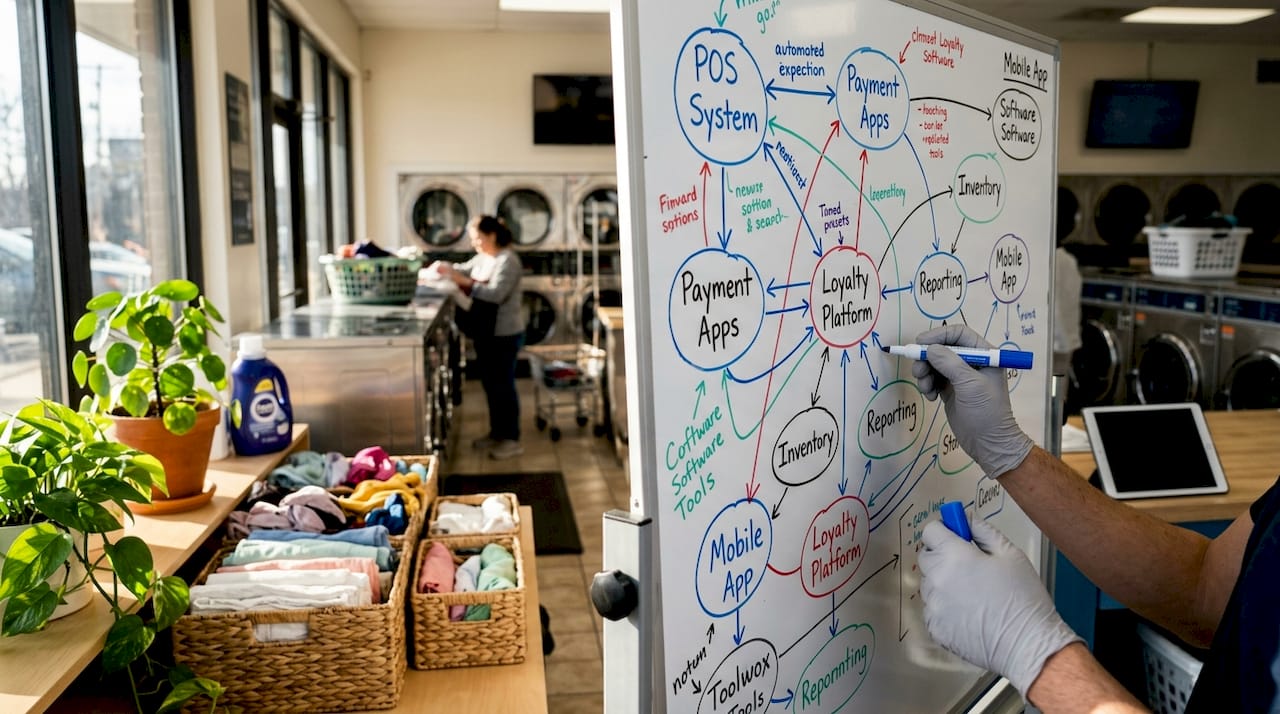
Pro Tip: Map every software tool your shop uses on a single whiteboard. Draw a line between any two tools that share data automatically. Every tool with no lines is a fragmentation risk.
The core problem is not that any one tool is bad. The problem is that independent “best-in-class” selections create data silos that no single person can see across. Owners end up managing the gaps between tools instead of managing their business.
How do fragmented systems hurt laundromat profitability and loyalty?
Fragmented laundry management does not just create inconvenience. It directly reduces revenue and drives customers away.
“Fully surrendering to third-party card systems without maintaining cash or hybrid payment options increases your vulnerability to tech failures and raises your per-transaction costs. Hybrid payment models protect profitability and operational continuity better than fully digital-only systems.”
The financial damage from software integration challenges appears in several places that owners often miss:
- Failed transactions. Every payment that does not process is revenue gone. A customer who cannot pay leaves and may not return.
- Hidden transaction fees. Relying on a third-party processor without a direct POS integration often means paying higher per-transaction rates with no visibility into true margins.
- Labor costs from manual work. When your POS and your payment system do not talk, someone has to reconcile them by hand. That labor cost is real and recurring.
- Machine profitability blind spots. Without integrating POS order numbers with machine payments, you cannot see which machines are actually profitable and which are dragging down your margins.
- Customer churn from friction. A loyalty app that fails to activate a machine after a customer has paid is not a minor bug. It is a broken promise that sends that customer to a competitor.
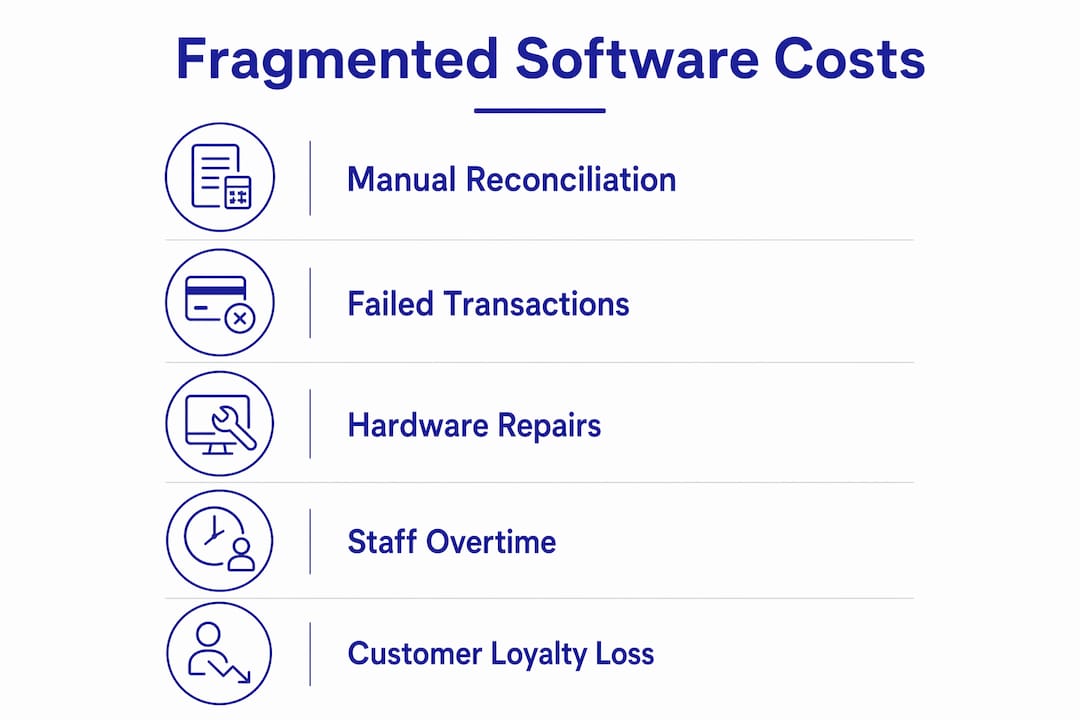
The hidden costs compound over time. Hardware repairs on mismatched systems, staff overtime for manual reconciliation, and lost repeat customers all add up to a profitability gap that owners rarely trace back to their software stack.
What are key technology strategies to overcome laundromat software fragmentation?
Solving fragmented laundry management requires a deliberate approach to platform selection and operational planning. The goal is fewer tools that share more data, not more tools that each do one thing well.
- Choose a unified platform first. Select software that covers POS, machine floor monitoring, payment processing, and order tracking in one system. Every integration you avoid is a failure point you eliminate.
- Require genuine offline capability. “Works without internet” is a marketing claim that can mislead if the system actually depends on a cellular modem inside a kiosk enclosure where signal degrades. Test offline mode yourself before you commit.
- Add cellular backup at the router level. A cellular failover router costs far less than a single lost revenue day. Configure offline modes and cellular backup before you need them, not during an outage.
- Avoid the point solution trap. Adding multiple unintegrated point solutions increases fragmentation with every new tool you add. Each new app that does not connect to your core system creates another data silo.
- Schedule updates at off-peak hours. Successful operators update software at 3:00 AM and keep spare hardware ready for failover testing. A failed update during peak hours is an avoidable crisis.
- Keep hybrid payment options. Maintaining coin or cash acceptance alongside card systems gives you a fallback when digital payments fail and serves customers who prefer cash.
Pro Tip: Before signing any software contract, ask the vendor to demonstrate a live internet outage simulation. If they cannot show you exactly what happens when connectivity drops, assume the worst.
| Strategy | Primary Benefit | Implementation Priority |
|---|---|---|
| Unified platform selection | Eliminates data silos | High |
| Cellular backup router | Prevents revenue loss during outages | High |
| Hybrid payment model | Reduces transaction fee exposure | Medium |
| Off-peak update scheduling | Avoids peak-hour disruptions | Medium |
| Offline mode verification | Confirms real, not claimed, resilience | High |
How to maintain security and compliance amid software fragmentation
Security risk grows with every additional software component you add to your stack. Each tool is a potential entry point, and fragmented systems are harder to patch consistently.
The most urgent security practices for laundromat operators are:
- Patch every component on a fixed schedule. Legacy software that is not updated regularly is the most common source of exploitable vulnerabilities. A known flaw like CVE-2026-4850 demonstrates that improper input validation in laundry software can allow remote database access. One unpatched module puts your entire customer data set at risk.
- Validate all input at every entry point. SQL injection attacks succeed because software accepts unfiltered input. Any system that handles customer data must sanitize inputs before processing them.
- Run quarterly vulnerability scans. A basic scan using widely available security tools will surface outdated components before attackers find them.
- Train staff on security basics. Attendants who share login credentials or leave terminals unlocked create human-layer vulnerabilities that no software patch can fix.
Pro Tip: Use per-device PIN security so staff can lock a terminal in seconds during a shift change. This one habit closes a significant portion of your human-layer risk at zero cost.
Balancing digital payment adoption with cash acceptance also serves a security function. A fully digital-only system means a single point of failure can halt all revenue. Keeping a cash option running in parallel gives you a fallback that no software exploit can disable.
Key Takeaways
Fragmented software is the single largest operational risk for independent laundromat owners, and unified platforms with proper offline configuration are the most direct solution.
| Point | Details |
|---|---|
| Fragmentation costs real money | Manual reconciliation, failed transactions, and hidden fees compound into significant annual losses. |
| Offline mode must be tested, not trusted | Cellular signal degradation inside kiosks can make “works offline” claims unreliable without direct verification. |
| Unified platforms outperform point solutions | A single system covering POS, payments, and machine monitoring eliminates the data silos that drive inefficiency. |
| Security risk scales with fragmentation | Every unpatched component in a fragmented stack is a potential entry point for exploitation. |
| Hybrid payments provide operational resilience | Maintaining cash alongside card systems protects revenue when digital payment tools fail. |
Why I think most laundromat owners solve fragmentation backwards
Most operators I talk to discover their software fragmentation problem after something breaks. A payment system goes down on a Friday night. A reconciliation takes six hours instead of one. A customer dispute over a lost garment cannot be resolved because the intake record lives in a different system than the order history. The instinct is to add another tool to fix the specific failure. That instinct makes the problem worse.
The “best-of-breed” approach sounds rational. Pick the best POS, the best payment processor, the best loyalty app. But each independent selection adds a new gap between systems, and those gaps are where your time, money, and customer trust disappear. I have seen operators running five separate platforms with zero shared data between them, spending more time managing software than managing their shop.
The operators who get ahead of this problem do two things differently. They select a platform that covers the core workflow before adding any specialty tools. And they treat integration as a non-negotiable requirement, not a nice-to-have feature. Staff alignment matters just as much as the technology. A unified platform that your team does not use consistently is still a fragmented operation.
The future of laundromat technology is moving toward centralized operating systems that connect every layer of the business. Owners who consolidate now will spend less time firefighting and more time growing.
— Artur
How Kansoflow addresses laundromat software fragmentation
Kansoflow is a native iOS POS and operations platform built specifically for laundromat owners who are done managing disconnected tools. The platform connects order tracking, payment processing via Stripe and Square, garment photo intake, and a visual Kanban board workflow in one place. There is no browser-based lag, no separate loyalty app to sync, and no manual reconciliation between systems. Kansoflow pairs natively with Bluetooth scales and Star Micronics printers, so your hardware and software speak the same language from day one. If you are ready to replace your fragmented stack with a single platform built for the shop floor, explore Kansoflow’s full feature set or visit kansoflow.com to see how it works in practice.
FAQ
What causes software fragmentation in laundromats?
Software fragmentation occurs when operators add multiple disconnected tools, such as separate POS, payment, and loyalty systems, that do not share data. Each independent selection creates a new gap in operational visibility and workflow continuity.
How does internet downtime affect laundromat payment systems?
Payment systems that require real-time cloud verification will stop processing transactions when internet connectivity drops. Properly configured offline modes and cellular backup routers prevent total revenue loss during outages.
What is the point solution trap in laundromat operations?
The point solution trap is the cycle of adding specialized tools to fix specific problems, which increases fragmentation with every addition. Each new unintegrated app creates another data silo and more manual work for staff.
How can laundromat owners protect against software security vulnerabilities?
Owners should patch every software component on a fixed schedule, run quarterly vulnerability scans, and enforce per-device PIN security for staff. Legacy systems with known flaws like SQL injection vulnerabilities represent the highest risk and should be replaced or updated immediately.
Is a hybrid payment model better than going fully cashless?
Hybrid payment models that include both card and cash options provide greater resilience than fully cashless systems. They protect revenue when digital payment tools fail and reduce dependence on third-party processors with high transaction fees.