Dry Cleaning Fragmented Software Problems: 2026 Guide

Fragmented software systems are the leading cause of operational breakdown in dry cleaning businesses. When your point of sale, scheduling tool, customer records, and billing platform do not share data, your staff spends hours every week manually reconciling information that should sync automatically. Employees in fragmented systems lose nearly 1.8 hours every day just searching for and reconciling information. That is roughly 20% of a full workweek gone before a single garment is pressed. Dry cleaning fragmented software problems are not a technology inconvenience. They are a direct tax on your revenue, your staff’s time, and your ability to grow.
How do dry cleaning fragmented software problems disrupt operations?
Software fragmentation in dry cleaning is defined as the condition where two or more business tools manage overlapping data without a shared connection. The industry term for this is “data silos,” and it describes exactly what happens when your POS does not talk to your scheduling app, or your customer database does not feed your billing system. The result is a shop floor where information lives in multiple places and no single view is ever fully accurate.
The operational damage shows up in four specific ways:
- Duplicate data entry. Staff type the same customer order into the POS, then again into a scheduling sheet, then again into an invoice. Each entry is a chance for error.
- Lost leads and communication gaps. A customer who called about a pickup gets missed because the note lived in one app that nobody checked before close.
- Scheduling inefficiencies. Without integrated data, managers cannot see equipment load and staff availability at the same time. Dry cleaning operations using fragmented scheduling lose 15–20% of potential efficiency, and managers spend 8–12 hours weekly on manual scheduling adjustments.
- Delayed decisions. When your sales report and your production log use different numbers, you cannot act on either with confidence.
Equipment utilization suffers most visibly. Poor integrated scheduling pushes equipment utilization below 70% and creates delivery routes that run 25–30% longer than necessary. That means machines sit idle while orders pile up, and drivers cover extra miles for no reason. Both outcomes cost money you do not see on any single report.
Pro Tip: Map one full order from intake to pickup and count every time a staff member manually re-enters or copies data. That count is your fragmentation score. Most dry cleaners find at least four redundant touchpoints.
Why fix software fragmentation before adopting AI?
The instinct many owners have is to add a smarter tool on top of their existing stack. An AI scheduling assistant sounds appealing. An automated customer texting system sounds even better. The problem is that AI automation only succeeds when the underlying data is unified. Fragmented systems do not just limit AI. They cause AI to scale your existing errors faster and at higher volume.
Think of it this way: if your customer database has three duplicate entries for the same person, an AI tool will send that person three automated messages. If your scheduling data conflicts with your production log, an AI optimizer will build a schedule based on false inputs. Integration is the foundation. Automation is the structure built on top of it.
The practical path forward involves three steps before any AI investment:
- Audit your current tool stack. List every platform your shop uses and identify which data each one owns.
- Establish a single source of truth per data domain. Businesses must pick one master system per data domain to avoid conflicting silos. One system owns customer records. One system owns order status. One system owns billing.
- Connect tools with native integrations or middleware. Platforms like Zapier or Make can bridge disconnected apps without requiring a full software replacement.
Integration is the foundation for automation and AI success. Fragmented data results in repeated inefficiencies at scale, not improvements. Fixing the data layer first means every tool you add afterward works with accurate, consistent information.
What are the symptoms and costs of fragmented cleaning software?
Dry cleaning owners often misread fragmentation symptoms as staff performance problems. An attendant who takes too long at the counter is not necessarily slow. She may be switching between three apps to complete one transaction. Operational inefficiency from data silos is frequently misattributed to poor staff performance when the real cause is infrastructure fragmentation requiring 4–10 hours weekly in manual data reconciliation.
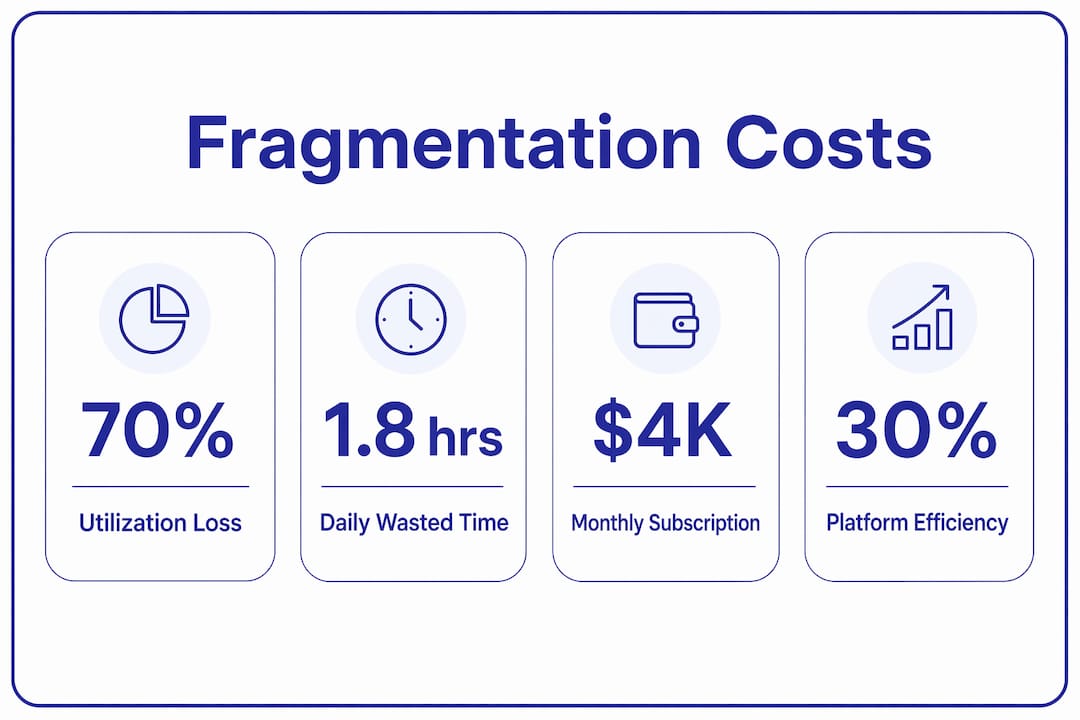
The costs are both visible and hidden. Small businesses average six or more platforms but fewer than 30% of those platforms are integrated. That means 70% of your tools are creating data that nobody else in your stack can read automatically. Twenty-seven percent of configuration time in small businesses is spent migrating and reconciling data between disconnected systems. That is more than a quarter of your setup effort producing zero new output.
| Symptom category | Real-world example | Cost implication |
|---|---|---|
| Duplicate subscriptions | Paying for two CRM tools that overlap | Wasted monthly spend |
| Manual reconciliation | Exporting CSVs to match billing with orders | 4–10 hours lost per week |
| Billing errors | Missed line items from disconnected POS | Direct revenue loss |
| Delayed reporting | End-of-week reports built from three sources | Slow decisions on staffing and inventory |
| Customer dissatisfaction | Missed pickup notifications from siloed comms | Churn and negative reviews |
Fragmented stacks incur hidden costs including delayed reporting, manual workarounds, and slowed decision-making. Slower decisions reduce your confidence in hiring, ordering supplies, and expanding to a second location. The invisible tax compounds quietly until it becomes a visible crisis.
Multiple software subscriptions also create redundant costs and operational delays. Reconciliation alone can cost 4–10 hours per week per team. For a two-person management team, that is a part-time employee’s worth of hours spent on work that integration would eliminate entirely.
How can dry cleaning businesses resolve software integration challenges?
Resolving dry cleaning technology problems does not require replacing everything at once. Incremental integration, starting with high-friction workflows and establishing clear data ownership before automating, is the proven path for small to mid-size businesses. Here is how to execute it:
- Audit your full tool stack. Write down every platform your shop uses, what data it holds, and who on your team uses it daily. Include spreadsheets and paper logs. Both count as systems.
- Rank workflows by friction. Identify the three processes that cause the most manual re-entry or the most errors per week. Start your integration work there, not with the easiest fix.
- Assign data ownership. Decide which system is the master record for customers, orders, and billing. Every other tool must pull from or push to that master. Never let two systems both claim to own the same data type.
- Use native integrations first. Many platforms offer built-in connections to common tools. Check these before paying for middleware. Native connections are faster and more stable.
- Add middleware for gaps. When native integrations do not exist, tools like Zapier or Make can automate data handoffs between apps. A common fix is automating the CRM-to-billing handoff so a closed order in your POS automatically creates an invoice.
- Automate incrementally. After each integration is stable and accurate, add one automation. Confirm it works for two weeks before adding the next. This builds confidence and catches errors early.
Pro Tip: Before buying any new software, ask the vendor one question: “What does your native integration list look like?” If the answer is vague or short, that tool will become another silo.
The most common technical barrier owners cite is not knowing which system to designate as the master record. The answer is almost always your POS. It is the first system to touch every order, so it is the logical owner of order data. Customer records belong in whichever tool your team checks most often when a customer calls. Billing belongs in whichever system your accountant already uses.
Why fragmentation is a leadership problem, not a software problem
The pattern I see most often is this: a dry cleaning owner buys a new app to solve a specific pain point, it works for that one thing, and then it creates two new disconnected data streams. Six months later, there are six platforms and nobody knows which one to trust. The problem was never the software. It was the absence of a decision about who owns what data.
Fragmentation almost always masquerades as a staff problem. The attendant is slow. The manager is disorganized. The reports are always wrong. When you dig into the actual workflow, you find that the attendant is slow because she is switching between three apps. The manager is disorganized because his scheduling tool does not match the POS. The reports are wrong because two systems both claim to own order status and they disagree.
The fix starts with a leadership decision, not a software purchase. Designate one master system per data domain and enforce it. That single decision eliminates more reconciliation hours than any new tool will. After that decision is made and the data is clean, incremental integration becomes straightforward. You are connecting accurate systems, not synchronizing conflicting ones.
The owners I have seen succeed at this do not replace everything at once. They pick the highest-friction workflow, fix the data handoff, confirm it runs cleanly for a month, and then move to the next one. That discipline is unglamorous. It is also the only approach that actually works without creating new problems.
— Artur
Kansoflow: one platform built to end the fragmentation cycle
Dry cleaning owners who have spent years juggling disconnected tools know the real cost is not just the hours lost. It is the confidence lost in every report, every schedule, and every customer interaction.
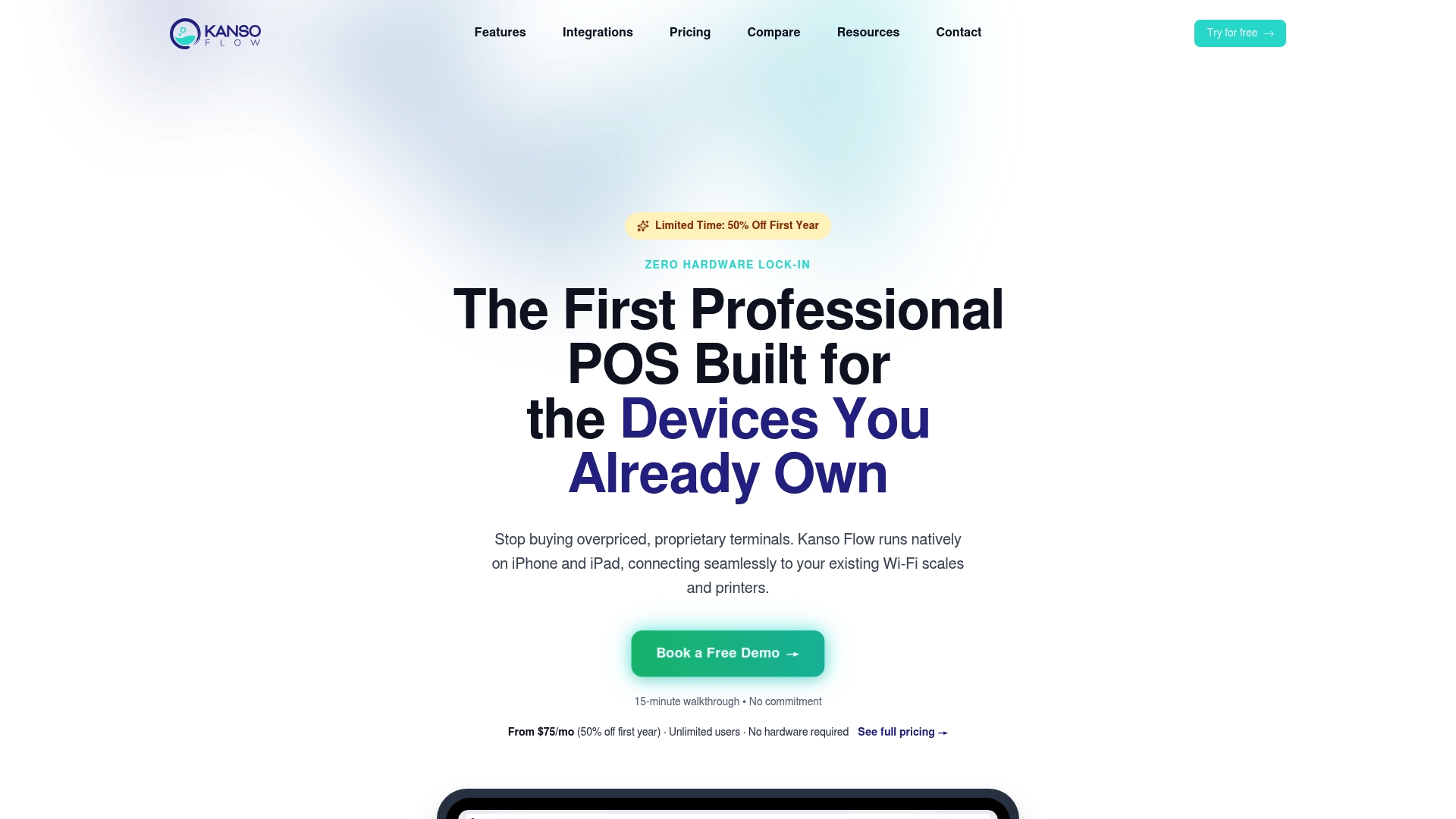
Kansoflow is a native iOS POS and management platform built specifically for laundromat and dry cleaning operations. It consolidates order tracking, garment photo intake, billing, inter-branch transfers, and hardware connections into a single app. There are no CSV exports, no manual syncs, and no conflicting reports. The visual Kanban board moves orders from intake through dry cleaning to ready status in one view, so your team always works from the same information. Kansoflow pairs natively with Star Micronics printers and Bluetooth scales, and processes payments through Stripe and Square. Visit kansoflow.com to see how a unified system changes what your operation can actually do.
FAQ
What are dry cleaning fragmented software problems?
Dry cleaning fragmented software problems occur when multiple disconnected tools manage overlapping business data without sharing it automatically. The result is manual reconciliation, duplicate entry, and inconsistent reports across your operation.
How much time does software fragmentation waste each week?
Employees in fragmented systems lose nearly 1.8 hours per day to searching and reconciling information, which equals roughly 20% of a full workweek. Reconciliation tasks alone can consume 4–10 hours per week per management team.
Should I fix software fragmentation before adding AI tools?
Yes. AI tools scale whatever data they receive. If your data is fragmented and inconsistent, AI automation will produce unreliable outputs and repeat your existing errors at higher speed. Unify your data first, then automate.
What is the first step to fixing fragmented cleaning software?
Audit every platform your shop currently uses and identify which data each one owns. Then designate one master system per data domain, starting with your POS for order data, and build integrations outward from there.
How does Kansoflow address software integration challenges?
Kansoflow consolidates order management, billing, garment tracking, and hardware connections into a single native iOS app. That eliminates the data handoffs between disconnected tools that cause most fragmentation problems in dry cleaning operations.
Key Takeaways
Fragmented software is a leadership and infrastructure problem, not a staff problem. Fixing data ownership before adding new tools is the single most effective step a dry cleaning owner can take.
| Point | Details |
|---|---|
| Fragmentation costs real time | Employees lose nearly 1.8 hours daily to manual reconciliation, equal to 20% of the workweek. |
| Integration must come before AI | AI tools scale errors from fragmented data; unified systems must exist first for automation to work. |
| Designate one master system | Pick one platform per data domain to eliminate conflicting data and reduce reconciliation hours. |
| Start with high-friction workflows | Fix the processes causing the most manual re-entry first, then move to lower-impact integrations. |
| Unified platforms cut hidden costs | Consolidating tools removes duplicate subscriptions, billing errors, and the hours spent reconciling reports. |