Dry Cleaning Enterprise Management: A 2026 Guide

Dry cleaning enterprise management is defined as the systematic coordination of operations, costs, staff, and technology across one or more locations to achieve consistent profitability. The industry term used by operators and consultants is “dry cleaning operations management,” though “enterprise management” captures the broader business function accurately. Most U.S. dry cleaners generate between $250,000 and $759,000 in annual revenue, with profit margins typically ranging from 5% to 15%. That range is wide, and where your business lands depends almost entirely on how well you manage the systems behind the counter.
What is dry cleaning enterprise management and why does it matter?
Dry cleaning enterprise management covers every decision that affects how your business runs, from how long a garment sits in the queue to how much you spend on chemicals per week. It is the operating framework that connects your front counter, your production floor, your staff schedules, and your financial reports into one coherent system.
Without this framework, owners make reactive decisions. They hire when they feel short-staffed, order supplies when they run out, and price services based on gut feel. With a defined management system, those same decisions become data-driven and predictable.
The concept applies equally to a single-location shop and a multi-site operation. At one location, enterprise management means tracking your key numbers and standardizing your workflow. At multiple locations, it means creating systems that run without you standing in the room.
Startup investments for dry cleaning businesses range from $50,000 to $500,000, with payback periods between 6 and 18 months. That payback window shortens significantly when owners apply disciplined cost control and operational consistency from day one.
What are the key performance indicators in dry cleaning business management?
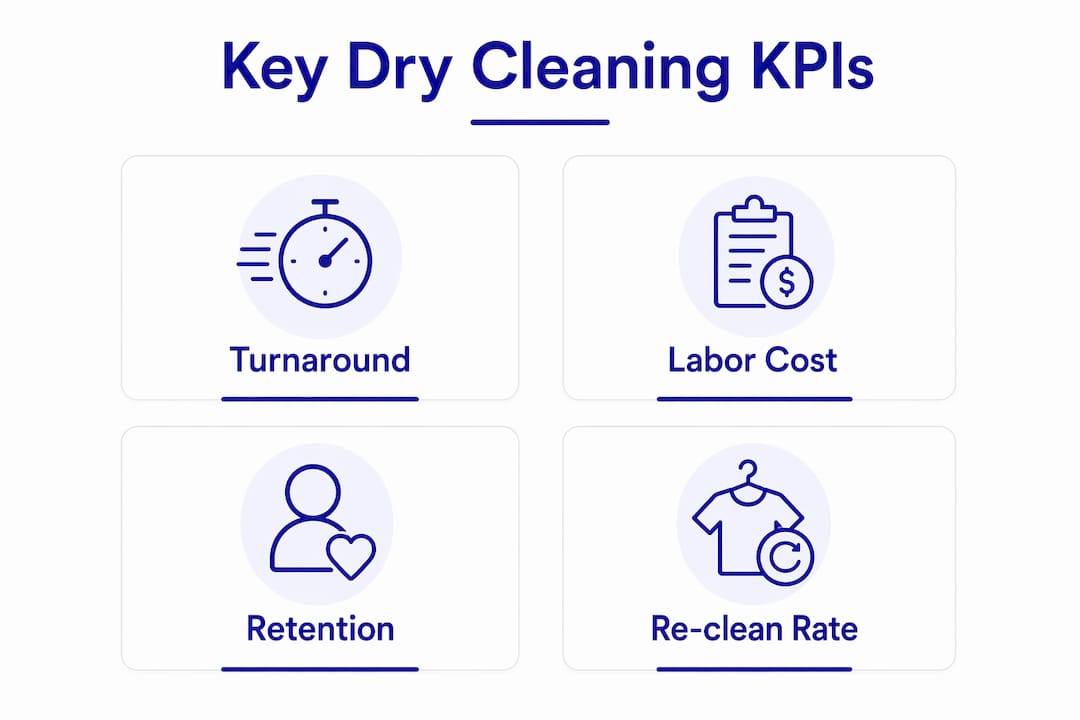
Five metrics define the health of a dry cleaning operation. Tracking all five gives you a complete picture. Ignoring even one creates a blind spot that costs money.
- Order Turnaround Time (TAT): The industry standard for TAT is 24–48 hours. Anything longer signals a bottleneck in production, staffing, or intake. Customers who wait longer than expected rarely return.
- Labor cost as a percentage of revenue: Labor accounts for 30%–40% of revenue in a typical dry cleaning shop. This is your largest controllable expense, and small scheduling inefficiencies compound quickly across a week.
- Customer retention rate: Retained customers cost far less to serve than new ones. Subscription models and loyalty programs directly improve this number by creating predictable visit frequency.
- Utility cost per garment: Utility cost per garment typically runs $0.25–$0.40. Tracking this figure reveals whether your equipment is running efficiently or burning money on every cycle.
- Average ticket size: This measures revenue per transaction. Upselling alterations, specialty cleaning, or rush service raises this number without adding a single new customer.
Pro Tip: Track these five KPIs weekly, not monthly. Monthly reviews hide problems that weekly data catches early, especially labor overruns and turnaround time creep.
A healthy business also monitors the Customer Lifetime Value to Customer Acquisition Cost ratio. A CLV to CAC ratio of at least 3:1 signals that your marketing spend is generating sustainable returns. Below that threshold, you are paying too much to acquire customers who do not stay long enough to be profitable.
How do cost management and efficiency drive profitability?
The three primary cost drivers in a dry cleaning operation are labor, rent and utilities, and supplies and chemicals. Labor runs 30%–40% of revenue. Rent and utilities consume another 20%–30%. Supplies and chemicals add 8%–15% on top of that. Together, these three categories can absorb 75% or more of gross revenue before you count anything else.
| Cost Category | Typical % of Revenue | Key Control Lever |
|---|---|---|
| Labor | 30%–40% | Scheduling software, cross-training staff |
| Rent and utilities | 20%–30% | Lease negotiation, energy-efficient equipment |
| Supplies and chemicals | 8%–15% | Bulk purchasing, waste tracking |
| Net profit (established shops) | 5%–15% | All of the above combined |
Net profits for established shops range from $25,000 to $113,000 annually. The difference between the low and high end is almost always operational discipline, not location or customer volume.
Lease terms deserve more attention than most owners give them. A favorable lease in a high-traffic area can outperform a cheap lease in a low-traffic one. Negotiate rent escalation caps and build-out allowances before signing. Energy-efficient machinery reduces utility cost per garment and pays for itself over time.
Re-clean rates and chemical waste are two metrics that quietly destroy margins. Every garment that comes back for a re-clean costs you labor, chemicals, and a dissatisfied customer. Tracking re-clean rates by employee or by garment type reveals exactly where your quality control is breaking down.
Pro Tip: Set a target re-clean rate below 2% of total orders. If you exceed that threshold in any given week, pull the data by employee and garment category before assuming it is a training issue. Sometimes it is a machine calibration problem.

What role does technology play in optimizing dry cleaning operations?
Technology is the fastest way to reduce manual errors and recover labor hours without adding headcount. The clearest example is garment tracking. Manual order processing takes 3–5 minutes per order. Automation can reduce processing errors by up to 70%, which means fewer lost items, fewer customer disputes, and less time spent on damage control.
AI-based garment tracking and route optimization systems can deliver return on investment within 3–8 months, improving labor efficiency by 15%–25% annually. Automation reduces lost garments, speeds customer communication, and improves delivery success rates across every route.
The impact of digital tracking extends beyond the production floor. When a customer calls to ask about their order, your staff should be able to answer in seconds, not minutes. That speed builds trust. Customers who trust your operation refer others and return more often.
Integration matters as much as the individual tools. A digital management platform that connects intake, production tracking, customer notifications, and payment processing eliminates the gaps where errors occur. Disconnected systems create handoff failures. A unified system creates accountability at every stage.
The key areas where technology delivers measurable returns include:
- Garment photo intake: Documenting condition at drop-off eliminates lost-item disputes before they start.
- Visual workflow tracking: A Kanban-style board lets staff see every order’s status at a glance, reducing the time spent asking “where is that order?”
- Automated customer notifications: Text or email alerts when orders are ready reduce phone volume and improve pickup rates.
- Route optimization for delivery: Dense, well-organized delivery routes cut fuel and labor costs while increasing the margin per route.
Kansoflow’s mobile POS platform addresses all four of these areas natively on iOS, without requiring proprietary hardware bundles or browser-based workarounds.
How to implement operations manuals for multi-location consistency
An operations manual is the single most underused tool in dry cleaning business management. Most owners carry their procedures in their heads. That works until they hire a second employee, open a second location, or take a week off.
Operations manuals ensure consistent procedures across employees and locations, enabling measurable performance comparisons and reducing dependency on individual knowledge. They also create the foundation for fair employee evaluations, because you cannot measure performance against a standard that was never written down.
Building an effective operations manual for a dry cleaning enterprise involves these steps:
- Document the intake process. Write out every step from greeting the customer to tagging the garment. Include photo documentation requirements and how to handle specialty items like leather, beaded garments, or wedding dresses.
- Define garment inspection standards. Specify what gets flagged before cleaning, how pre-existing damage is recorded, and who signs off on the inspection.
- Standardize production workflows. Map the physical path a garment takes from intake to rack. Identify every handoff point and who is responsible at each stage.
- Write customer-facing protocols. Cover how staff handle complaints, lost items, and damage claims. Include your privacy policy for customer data.
- Set performance benchmarks. Define what “good” looks like for TAT, re-clean rate, and customer satisfaction. Use these benchmarks to evaluate staff consistently across locations.
Operations manuals are living tools that enable apples-to-apples comparisons for employee and location performance. Update yours whenever a process changes, and review it with staff at least quarterly.
Pro Tip: Record short video walkthroughs of key procedures and link them inside the manual. New employees absorb visual instructions faster than written ones, and video reduces the time a manager spends on one-on-one training.
What practical strategies help dry cleaning owners grow profitability?
Growth in a dry cleaning enterprise comes from two directions: increasing revenue per customer and reducing cost per order. The most effective tactics address both simultaneously.
- Add pickup and delivery service. Pickup and delivery increases order volume by 20%–40% and improves customer retention. Customers who use delivery services visit more frequently and spend more per transaction because convenience removes the friction of dropping off in person.
- Batch and plan delivery routes. Dense routes reduce fuel and labor costs. Route planning software turns scattered stops into efficient loops, cutting the cost per delivery while increasing the number of orders per driver.
- Upsell alterations and premium services. Alterations, leather cleaning, and wedding gown preservation carry higher margins than standard dry cleaning. Training staff to mention these services at intake raises average ticket size without adding new customers.
- Monitor CLV versus acquisition cost. Every marketing dollar should generate at least $3 in lifetime customer value. If it does not, the channel is not worth the spend.
- Scale through additional locations or franchise agreements. Once your operations manual and KPI tracking are solid, replicating the model at a second location becomes a systems exercise rather than a reinvention.
The owners who grow fastest are not the ones who work the most hours. They are the ones who build systems that work without them.
Key Takeaways
Dry cleaning enterprise management succeeds when owners track the right metrics, control the three major cost categories, and build systems that run consistently without depending on any single person.
| Point | Details |
|---|---|
| Define your KPIs | Track TAT, labor cost, retention rate, utility cost per garment, and average ticket size weekly. |
| Control the big three costs | Labor, rent, and supplies consume up to 75% of revenue. Each requires a specific control strategy. |
| Invest in technology | Automation reduces processing errors by up to 70% and delivers ROI within 3–8 months. |
| Build an operations manual | Documented procedures create consistent quality and enable fair performance comparisons across locations. |
| Add delivery service | Pickup and delivery increases order volume by 20%–40% and improves long-term customer retention. |
What I have learned from watching dry cleaning businesses succeed and fail
The owners who struggle most are not the ones with bad locations or weak demand. They are the ones who run everything from memory. They know their business deeply, but that knowledge lives only in their heads. The moment they hire a third employee or consider a second location, the whole operation becomes fragile.
The operators I have seen grow consistently share one habit: they write things down before they need to. They document a procedure when it works, not after it breaks. That discipline creates a business that can be measured, taught, and replicated.
KPIs are not just for accountants. A TAT creeping from 36 hours to 52 hours is a warning sign visible only if you are tracking it. Most owners feel the problem before they see it in the numbers. The ones who track weekly catch it before it becomes a customer complaint.
Technology is not a replacement for good operations. It is an amplifier. A shop with bad intake procedures and a digital tracking system will lose garments faster and with better documentation. Fix the process first, then automate it. The ROI on automation is real, but only when the underlying workflow is sound.
— Artur
How Kansoflow supports dry cleaning enterprise management
Kansoflow is a native iOS POS and operations platform built specifically for laundromat and dry cleaning owners who are done managing their business on paper tickets and spreadsheets. Its Visual Kanban Board tracks every order through Wash, Fold, Dry Cleaning, and Ready stages in real time. Photo Intake captures garment condition at drop-off, eliminating the disputes that drain staff time and damage customer trust. For multi-location owners, Kansoflow handles inter-branch garment transfers and third-party outsourcing from a single interface. Explore the full feature set for operators and see how the platform fits your operation.
FAQ
What is dry cleaning enterprise management?
Dry cleaning enterprise management is the systematic coordination of operations, costs, staff, and technology across one or more locations to achieve consistent profitability. It includes tracking KPIs, controlling major cost categories, and standardizing workflows.
What profit margin should a dry cleaning business target?
Profit margins for established dry cleaning shops typically range from 5% to 15%, with net profits between $25,000 and $113,000 annually depending on location, scale, and cost control.
How long does order turnaround take in a well-run dry cleaning operation?
The industry standard for Order Turnaround Time is 24–48 hours. Anything beyond that signals a production or staffing bottleneck that directly affects customer retention.
Why do dry cleaning businesses need an operations manual?
Operations manuals create consistent procedures across employees and locations, enable fair performance comparisons, and reduce the business’s dependency on any single person’s knowledge.
How much can pickup and delivery service increase revenue?
Adding pickup and delivery service increases order volume by 20%–40% and improves customer retention by removing the friction of in-person drop-off visits.